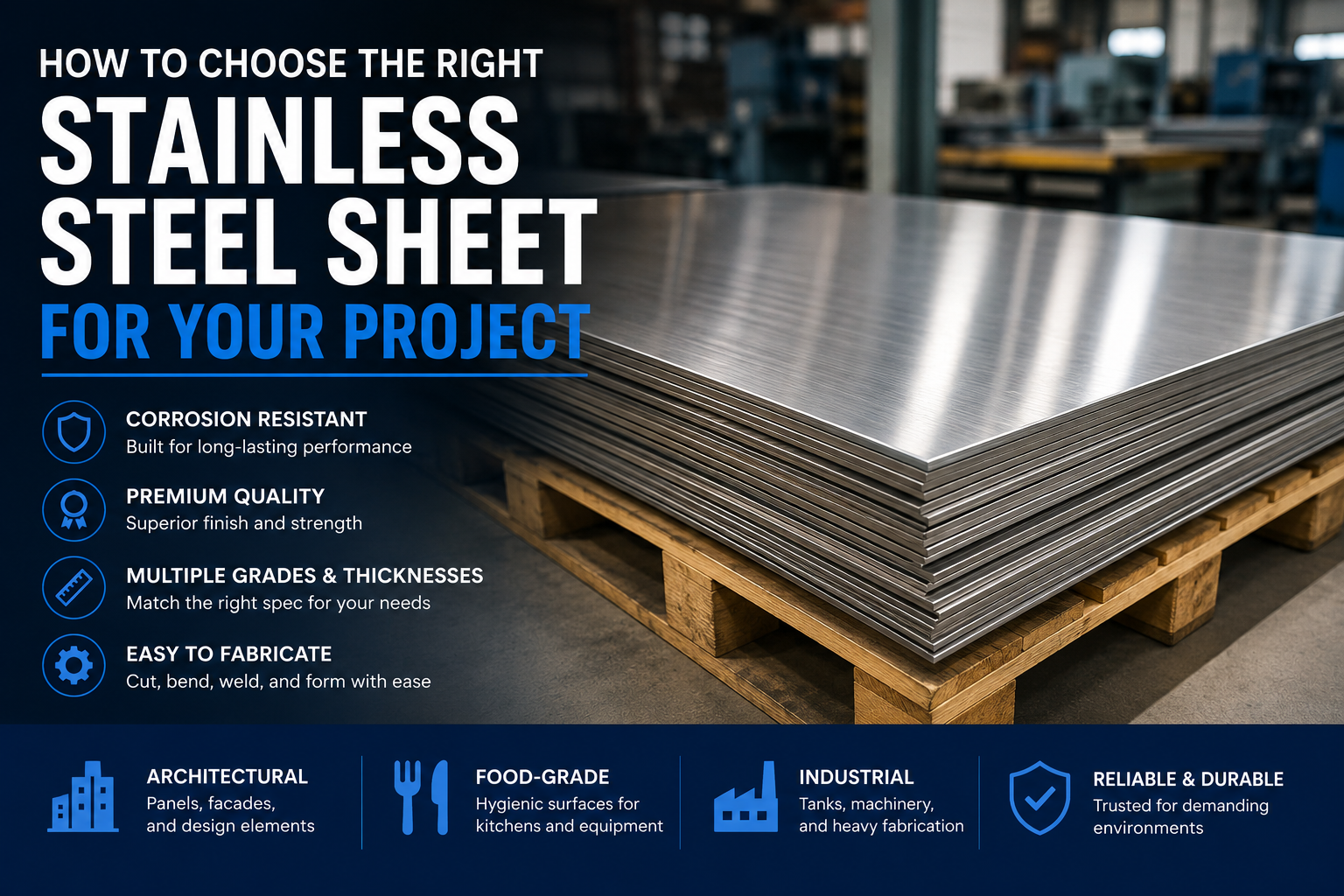
Choosing the right stainless steel sheet stainless steel sheet means matching the correct grade, finish, and thickness to the specific demands of your application. The wrong choice leads to premature corrosion, structural failure, or unnecessary cost. The right choice delivers decades of durability, easy maintenance, and a professional finish.
Whether you are working on an architectural feature, a food-grade surface, or a heavy fabrication job, this guide gives you the framework to choose with confidence.
Why are Stainless Steel Sheets a Top Material Choice?
Stainless steel is one of the most versatile materials in manufacturing, construction, and design. Its chromium content creates a passive oxide layer that resists rust, chemical damage, and heat, making it reliable across a wide range of environments.
According to Market Research Future, the global stainless steel sheet market was valued at $48.13 billion in 2024 and is projected to reach $87.17 billion by 2034, growing at a CAGR of 6.1%, driven by demand from construction, automotive, and industrial manufacturing sectors.
Grand View Research reports that the U.S. stainless steel market generated $9.81 billion in revenue in 2024 and is expected to reach $15.35 billion by 2030 at a CAGR of 7.8%, with the 300 series accounting for the largest revenue share at 63.74%.
How to Select the Right Stainless Steel Sheet for Your Work?
Step 1: Select the Right Grade
The grade of your stainless steel sheet determines its corrosion resistance, strength, and suitability for different environments.Grade 304 is the most widely used option for general purposes. Grade 316 is the right choice anywhere moisture, salt, or chemicals are present. For budget-conscious interior projects, 430 provides adequate performance at a lower price point.Grade Key Properties Best Applications 304 Excellent corrosion resistance, easy to fabricate Kitchen equipment, sinks, architectural panels 316 Enhanced resistance to chlorides and acids Marine environments, medical devices, coastal construction 430 Magnetic, lower cost, moderate corrosion resistance Appliance panels, decorative interior uses 2205 Duplex High strength, superior chloride resistance Chemical processing, offshore structures Step 2: Choose the Right Finish
The finish affects both the appearance and the functional performance of the sheet. It also determines how easily the surface can be cleaned and how well it resists contamination.
Brushed stainless steel sheets feature a unidirectional satin texture created by abrasive finishing. They are the most popular choice for commercial kitchens, elevator interiors, and architectural cladding because they hide fingerprints and minor scratches effectively. The brushed finish also complements modern design aesthetics.
Polished stainless steel sheets have a smooth, mirror-like surface produced by progressive polishing to a high reflective sheen. They are used in decorative applications, signage, high-end appliances, and food-grade environments where visual presentation matters. Polished surfaces require more frequent cleaning to maintain their appearance.
Other available finishes include No. 1 (hot rolled, rough), No. 2B (smooth, matte, the most common mill finish), and embossed or patterned finishes for specialized decorative uses.Step 3: Match the Thickness to Your Application
Sheet thickness directly determines load capacity, formability, and weight.Thin stainless steel sheets are ideal for applications where weight reduction is critical or where the material is fitted over a substrate. Industrial stainless steel sheets at heavier gauges are designed for load-bearing, high-impact, and high-temperature applications in manufacturing plants, processing facilities, and construction.Thickness Range Common Use Case 0.5mm to 1.0mm Thin stainless steel sheets for backsplashes, cladding, enclosures 1.2mm to 2.0mm General fabrication, countertops, trim panels 3.0mm to 6.0mm Structural applications, industrial platforms, machine guards 8.0mm and above Heavy industrial stainless steel sheets, pressure vessels, tanks Step 4: Consider the Fabrication Requirements
Before placing an order, consider how the sheet will be cut, bent, welded, or formed. Harder grades like duplex stainless are more difficult to machine. Thinner gauges are easier to form but less forgiving under stress.
If your project involves welding, confirm that the filler material is compatible with your chosen grade. For projects requiring tight tolerances, laser-cut sheets offer the highest precision.
Which are the Common Stainless Steel Sheet Selection Mistakes to Avoid?
Using the wrong grade in a high-salt or chemical environment is the most common and costly error. Specifying a polished finish for a high-traffic surface that will accumulate fingerprints and scratches is another frequent misstep. Underestimating required thickness in structural applications creates safety and compliance risks.
Always consult with a metal supplier who understands your end-use environment before finalizing your specification.
Get Expert Guidance from BobCo Metals
Selecting the right stainless steel sheet for your project requires matching grade, finish, thickness, and fabrication requirements precisely. Getting it wrong costs time, money, and project quality.
BobCo Metals is a trusted metal supplier providing high-quality brushed, polished, industrial, and thin stainless steel sheets with expert guidance at every step. Their team helps contractors, fabricators, architects, and manufacturers find the exact specification they need at a competitive price.
Visit our website to find the type of product you require. You can also call us directly at 800-262-2605.
Frequently Asked Questions (FAQs)
- 1. What is the most common grade of stainless steel sheet?
Grade 304 is the most widely used stainless steel sheet grade, offering a strong balance of corrosion resistance, workability, and cost. It suits most general applications, including food service, architectural, and light industrial uses. - 2. What is the difference between brushed and polished stainless steel sheets?
Brushed stainless steel sheets have a textured, matte finish that hides scratches and fingerprints, making them ideal for high-traffic surfaces. Polished stainless steel sheets have a mirror-like finish suited for decorative and hygienic applications that require visual impact. - 3. What thickness of stainless steel sheet do I need for a countertop?
For most countertop applications, a thickness of 1.2mm to 1.6mm over a plywood or steel substrate is standard. Freestanding countertops without a base support typically require 1.5mm to 2.0mm for adequate rigidity. - 4. Can stainless steel sheets be used outdoors?
Yes. Grade 316 stainless steel sheets are specifically formulated for outdoor and coastal environments due to their enhanced resistance to chlorides and saltwater. Grade 304 is suitable for standard outdoor use in non-marine environments. - 5. What are industrial stainless steel sheets used for?
Industrial stainless steel sheets are used in manufacturing equipment, chemical processing vessels, pressure tanks, food processing machinery, pharmaceutical facilities, and heavy fabrication where strength, hygiene, and corrosion resistance are critical. - 6. How do I cut thin stainless steel sheets cleanly?
Thin stainless steel sheets can be cut cleanly using a plasma cutter, laser cutter, or angle grinder with a stainless steel cutting disc. Shears work well for straight cuts on very thin gauges. Always use cutting tools rated for stainless steel to avoid contamination and edge damage.