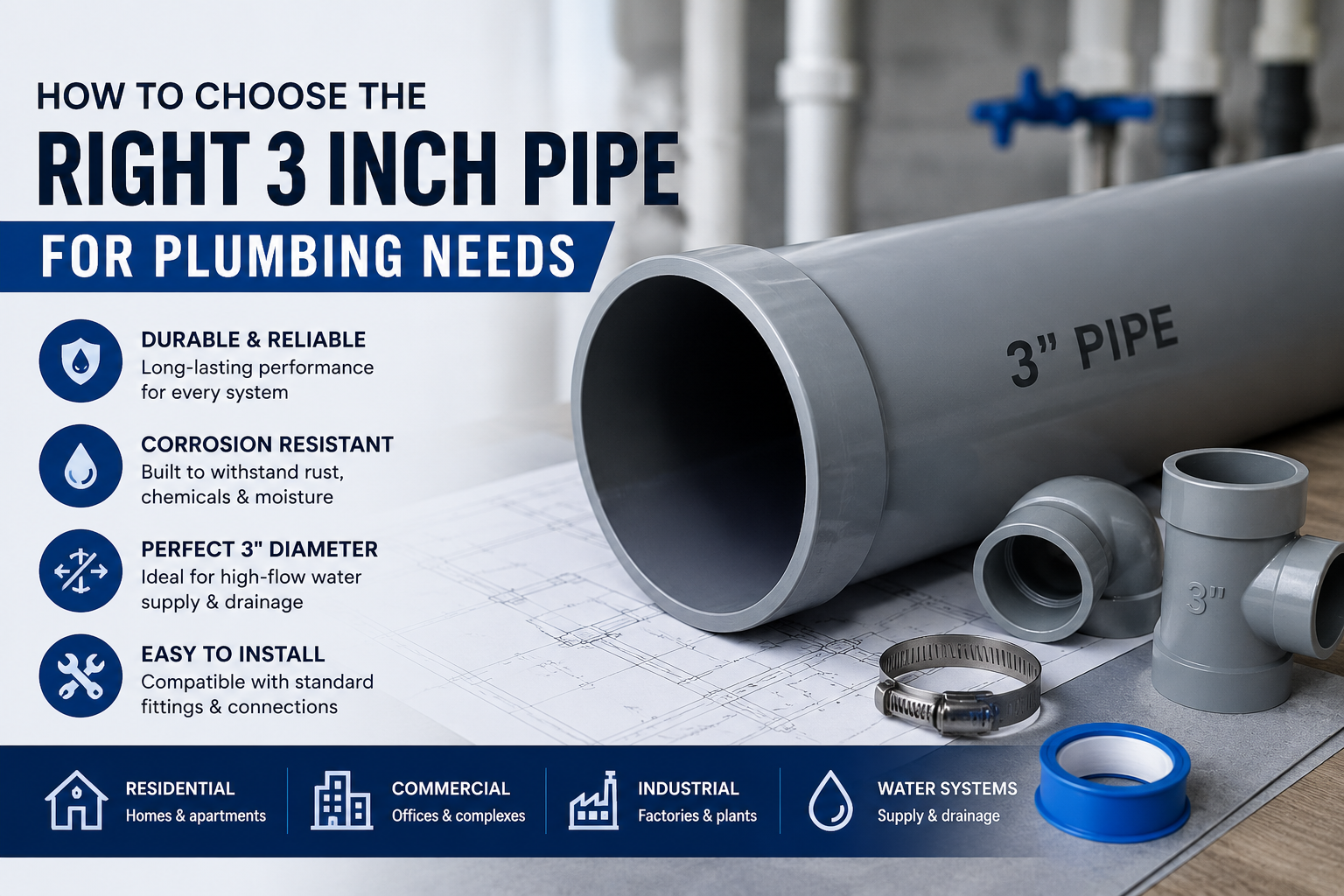
Choosing the right 3-inch pipe comes down to understanding your system type, pressure requirements, fluid type, local code, and whether you need rigid or fittings-based connections. Whether you are a homeowner managing a repair, a contractor sourcing materials for a new build, or a facilities manager planning an upgrade, this guide gives you everything you need to make a confident, code-compliant pipe selection.
What is a 3 Inch Pipe?
A 3 inch pipe is a mid-size plumbing pipe used for drain, waste, and vent systems in residential and commercial construction, with material choice determined by the application: 3 inch PVC pipe is the standard for drain lines and vent stacks, 3 inch galvanized pipe is used in legacy water supply systems and structural applications, and 3 inch drain pipe is required by most building codes for toilet drain lines and branch drain runs connecting to the main stack.
Why Pipe Material Matters More Than Most Buyers Realize
Not all 3 inch pipe is interchangeable. Using the wrong material in a given application can lead to premature failure, code violations, health hazards, and costly remediation. Each pipe material has specific pressure ratings, temperature tolerances, chemical resistance profiles, and approved use cases under the International Plumbing Code (IPC) and local building codes.
The decision tree is straightforward when you understand the categories. Here is how the primary materials used in 3 inch pipe applications break down by use case.
I. 3 Inch PVC Pipe for Drain, Waste, and Vent
3 inch PVC pipe is the most widely used material for residential drain, waste, and vent (DWV) systems. It is lightweight, corrosion-resistant, affordable, and easy to cut and join using solvent cement fittings. PVC is approved for use in drain and vent applications under virtually all major building codes and is the default choice for new residential construction.
Key characteristics of 3 inch PVC pipe:- Pressure rating: Schedule 40 PVC rated to 260 PSI at 73 degrees Fahrenheit (not intended for pressure lines at elevated temperatures)
- Temperature tolerance: Suitable for cold and ambient-temperature water; not recommended for continuous hot water supply lines above 140 degrees Fahrenheit
- Common applications: Toilet drain lines, tub and shower drains, sink drain runs, vent stacks, underground drainage
- Connection method: Solvent cement welding with compatible PVC fittings
- Code approvals: ASTM D2665 (DWV), ASTM D1785 (Schedule 40 pressure)
Schedule 40 is the most common wall thickness for residential DWV applications. Schedule 80 offers a thicker wall and higher pressure rating for more demanding conditions.3 Inch Drain Pipe: Sizing Requirements and Code Compliance
When plumbers and contractors refer to 3 inch drain pipe, they are typically referencing Schedule 40 PVC or ABS pipe sized specifically for residential drain line routing. Under the Uniform Plumbing Code (UPC) and the International Residential Code (IRC), a 3 inch drain line is the minimum required size for toilet drain connections (also called water closet drains) in residential construction.
A single 3 inch drain line can serve a toilet plus other fixtures within the same branch, depending on the drainage fixture unit (DFU) load calculation. For whole-house drain systems, the main stack is typically 4 inches, with 3 inch branch lines feeding into it.
Understanding DFU load limits helps you avoid undersizing branch drains:
| Fixture | Drainage Fixture Units (DFU) |
|---|---|
| Toilet (water closet) | 4 DFU |
| Bathtub or shower | 2 DFU |
| Bathroom sink (lavatory) | 1 DFU |
| Kitchen sink | 2 DFU |
| Washing machine standpipe | 2 DFU |
| 3 inch drain pipe capacity | Up to 20 DFU (horizontal branch) |
3 Inch PVC Pipe Fittings: Completing the System
No pipe system is complete without the right fittings. 3 inch pipe fittings connect lengths of pipe, change direction, create branch connections, and terminate lines. For PVC drain systems, always use DWV-rated fittings, not pressure fittings, as DWV fittings have a sweep design that allows waste to flow smoothly without obstruction.
Common 3 inch pipe fittings include:- Sanitary tees are used where a branch line joins the main vertical stack.
- Wye fittings are used in horizontal-to-horizontal branch connections.
- 45-degree and 90-degree elbows change direction, with long-sweep elbows preferred in drain lines to reduce clogging risk.
- Couplings connect two straight sections of pipe.
- Cleanout fittings provide access for drain clearing and are required by code at specific intervals.
- Reducer bushings and fittings connect 3 inch runs to smaller diameter lines.
II. 3 Inch Galvanized Pipe for Legacy Systems and Structural Applications
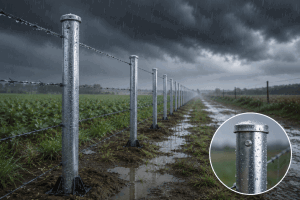
3 inch galvanized pipe is steel pipe coated with a zinc layer to resist corrosion. It was the standard for residential water supply lines in homes built before the 1980s and remains in use for certain structural, industrial, and gas line applications today.
In older homes, 3 inch galvanized pipe in water supply lines is increasingly being replaced due to internal corrosion over time. As galvanized steel ages, the zinc coating deteriorates from the inside outward, leading to rust accumulation, reduced water flow, and eventually, pinhole leaks or pipe failure.
Galvanized pipe is still a valid choice for applications that include gas distribution lines (where approved and properly rated), outdoor structural railings and frames, industrial conveying systems, and fire suppression systems in certain configurations.
Important: Never connect galvanized pipe directly to copper pipe without a dielectric union. Direct contact between these two metals causes galvanic corrosion at the joint.III. 3 Inch Water Pipe: Material Selection for Supply Lines
For pressurized water supply applications at 3 inch diameter, the material options shift significantly. 3 inch water pipe for supply systems is typically made from copper, CPVC, PEX-A, or in commercial settings, ductile iron or schedule 80 PVC.
Copper is durable, antimicrobial, and code-approved for potable water, but significantly more expensive than plastic alternatives. CPVC handles both hot and cold water and is rated to 200 degrees Fahrenheit, making it suitable for hot water mains. PEX is flexible, freeze-resistant, and increasingly used in residential new construction and retrofits.
At the 3 inch size, most residential systems are at the main service entry or large trunk lines. Commercial buildings, apartment complexes, and facilities with high simultaneous demand are more commonly specifying 3 inch water pipe for cold water trunk distribution.
Comparing 3 Inch Pipe Materials at a Glance
This comparison highlights the key differences between 3 inch pipe materials across every major category.
| Material | Best Use | Temperature Limit | Corrosion Resistance | Cost (Relative) |
|---|---|---|---|---|
| PVC Schedule 40 | DWV drain and vent | 140°F | Excellent | Low |
| PVC Schedule 80 | Pressure applications | 140°F | Excellent | Moderate |
| Galvanized Steel | Gas lines, structural, legacy supply | 400°F | Moderate (degrades over time) | Moderate |
| CPVC | Hot and cold water supply | 200°F | Excellent | Moderate |
| Copper | Potable water supply | 400°F | Excellent | High |
| PEX | Residential water supply | 200°F | Excellent | Low to Moderate |
How to Select the Right 3 Inch Pipe: A Quick Decision Guide
Drain line for toilet or branch run
Use 3 inch PVC Schedule 40 DWV pipe with sanitary fittings.Hot water supply trunk line
Use CPVC or copper rated for your system pressure.Older home with galvanized supply
Consider full replacement with PEX or copper; consult a licensed plumber.Outdoor structural or gas application
Use appropriately rated galvanized or black steel pipe.Underground drainage
Use SDR-35 or Schedule 40 PVC with properly rated underground fittings.
Wrapping Up
Whether you need 3 inch PVC pipe, 3 inch galvanized pipe, 3 inch pipe fittings, or specialty pipe for a commercial or industrial application, selecting the right material from the start saves time, money, and rework down the line.
BobCo Metals stocks a comprehensive inventory of pipe materials sized and rated for professional-grade plumbing, construction, and industrial applications. With deep product knowledge, competitive pricing, and reliable availability, BobCo Metals is the trusted source for contractors, facility managers, and serious DIYers who need the right pipe the first time. Visit BobCo Metals today to find the right 3 inch pipe for your project.
Frequently Asked Questions (FAQs)
- 1. What is a 3 inch pipe used for in plumbing?
A 3 inch pipe is most commonly used for toilet drain lines, branch drain runs, and vent stacks in residential plumbing systems. Under the International Residential Code, 3 inch is the minimum required diameter for water closet (toilet) drain connections. It is also used for horizontal branch drains collecting waste from multiple fixtures before connecting to the main 4 inch stack. - 2. What is the difference between 3 inch PVC pipe and 3 inch ABS pipe?
Both 3 inch PVC pipe and ABS pipe are used in DWV applications, but they have different material compositions. PVC is white or gray, requires solvent cement, and is slightly more rigid and impact-resistant in cold temperatures. ABS is black, also uses solvent cement, and is slightly more flexible. They cannot be joined directly to each other without a transition fitting and approved transition cement. Local codes may specify one over the other. - 3. Can 3 inch PVC pipe be used for water supply lines?
Standard Schedule 40 PVC is not approved for hot water supply lines because it softens at elevated temperatures. It can be used for cold water pressure applications when properly rated. For hot and cold water supply, CPVC is the appropriate plastic alternative. For potable water supply in a 3 inch size, copper or CPVC is the preferred choice in most residential and commercial applications. - 4. What 3 inch pipe fittings do I need for a toilet drain line?
A typical toilet drain connection requires a 3 inch closet flange (the fitting that mounts to the floor and accepts the toilet), a 3 inch sanitary tee or wye where the toilet drain joins the branch line, and 90-degree or 45-degree long-sweep elbows for direction changes. All fittings should be DWV-rated Schedule 40 PVC for residential applications, joined with purple primer and PVC cement. - 5. How long does 3 inch galvanized pipe last in a water supply system?
3 inch galvanized pipe in residential water supply systems typically lasts 40 to 70 years before internal corrosion becomes a significant problem, though lifespan varies based on water chemistry, water pressure, and local conditions. Signs of end-of-life include discolored water, reduced flow, rust staining at fixtures, and visible exterior corrosion. In many older homes, replacing galvanized pipe with copper or PEX is the recommended long-term solution. - 6. What is the pressure rating for 3 inch Schedule 40 PVC pipe?
3 inch Schedule 40 PVC pipe has a pressure rating of approximately 260 PSI at 73 degrees Fahrenheit. This rating decreases as temperature increases. At 140 degrees Fahrenheit, the working pressure drops to roughly 50% of the rated capacity. For this reason, Schedule 40 PVC is not used for hot water pressure supply lines, though it is fully suitable for DWV drain and vent applications, which operate at or near atmospheric pressure. - 7. Can I connect 3 inch galvanized pipe to PVC pipe?
Yes, but a transition fitting is required. A rubber coupling with stainless steel clamps (commonly called a Fernco or no-hub coupling) is the standard method for connecting 3 inch galvanized pipe to 3 inch PVC in drain systems. For water supply connections between galvanized and copper, use a dielectric union to prevent galvanic corrosion. Do not join dissimilar metals directly without appropriate isolation fittings. - 8. What is the difference between 3 inch Schedule 40 and Schedule 80 PVC pipe?
The key difference is wall thickness and pressure rating. Schedule 40 has a thinner wall and lower pressure rating, making it the standard choice for residential DWV and light-duty pressure applications. Schedule 80 has a thicker wall, a higher pressure rating, and greater impact resistance, making it suitable for more demanding pressure applications and areas where the pipe may be exposed to physical damage. Schedule 80 costs more and has a slightly smaller interior diameter than Schedule 40 of the same nominal size.