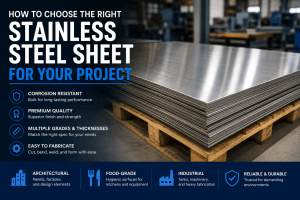
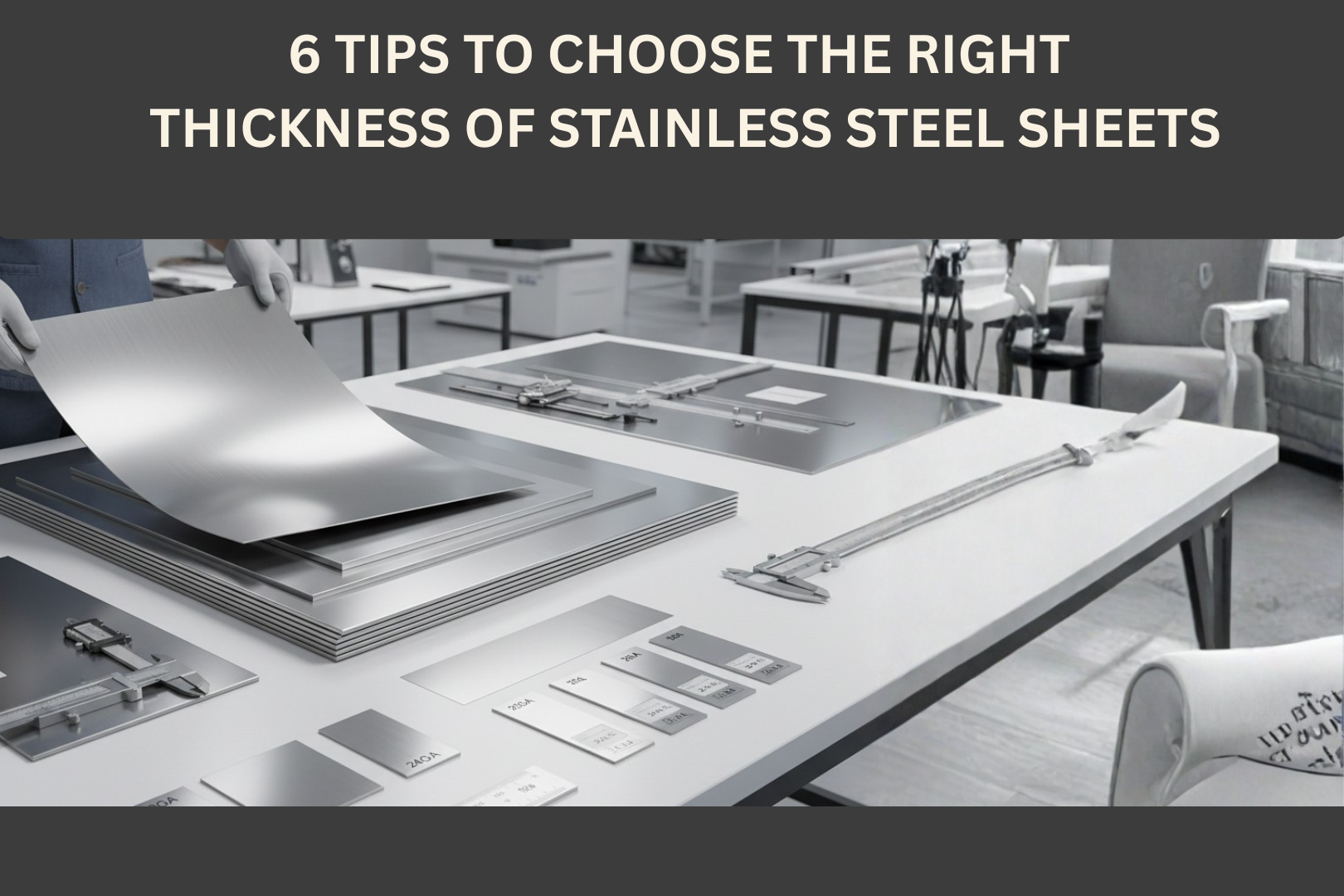
Selecting the appropriate thickness for stainless steel sheets is a crucial decision. Strength, longevity, cost, and long-term performance are all directly impacted. You run the risk of bending, denting, or premature wear if you go too thin.
If you go overboard, you risk overspending without delivering any tangible benefits.
The application, load requirements, and environment all play a role in making the best decision. Here's the smart way to go about it.
1. Understand Gauge vs. Thickness
Gauge is frequently used to measure stainless steel sheets. The thickness of the sheet increases with decreasing gauge number. Ten-gauge is thicker than eighteen-gauge, for instance. When accuracy is crucial, always confirm the thickness in inches or millimeters.
For example:
- 22 gauge is about 0.030 inches
- 18 gauge is about 0.048 inches
- 14 gauge is about 0.075 inches
- 10 gauge is about 0.135 inches
Precision matters when structural integrity is involved.
2. Match Thickness to Structural Needs
Thickness is required if the stainless steel sheets are going to support weight, withstand impact, or be used with heavy machinery. Stronger gauges are required for load-bearing applications, heavy-duty panels, industrial kitchen countertops, and structural elements.
Decorative wall panels or light coverings may require much thinner sheets.
Common Applications and Typical Thicknesses
| Application | Typical Gauge | Approx. Thickness | Why This Thickness Is Used |
|---|---|---|---|
| Decorative Wall Panels | 22–20 gauge | 0.030–0.036 in | Lightweight, easy to install, cost efficient |
| Residential Kitchen Backsplashes | 20–18 gauge | 0.036–0.048 in | Resists minor dents and heat exposure |
| Commercial Kitchen Countertops | 16–14 gauge | 0.060–0.075 in | Handles heavy use and food prep impact |
| Elevator Panels | 18–16 gauge | 0.048–0.060 in | Balances strength with aesthetic finish |
| Equipment Enclosures | 16–14 gauge | 0.060–0.075 in | Provides structural rigidity |
| Industrial Flooring or Platforms | 12–10 gauge | 0.105–0.135 in | Supports heavy loads and traffic |
| Structural Brackets or Supports | 10 gauge and thicker | 0.135 in+ | Maximum strength for load-bearing applications |
3. Consider Environmental Exposure
Even though stainless steel doesn't corrode, in harsh environments, thickness is important. For increased durability and warp resistance, slightly thicker sheets may be preferable in areas subjected to moisture, chemicals, or high temperatures.
In high-traffic or outdoor environments, durability pays off long term.
4. Account for Fabrication and Welding
Sheets of thicker stainless steel are better able to withstand the stress of welding and fabrication without deforming. But cutting or shaping thicker sheets also takes more effort and power. Strike a balance between thickness and workability if your project calls for intricate fabrication or intricate bends.
Practical installation matters just as much as performance.
5. Factor in Weight and Cost
The weight and cost per square foot of thicker stainless steel sheets are higher. The budget for large-scale projects may be greatly impacted by that discrepancy. You can avoid paying for strength you don't really need by selecting the right thickness.
Efficiency is about precision, not excess.
6. Review Industry Standards and Codes
Minimum thickness requirements may be necessary for specific industries, including construction, healthcare, and food processing. Prior to placing an order, make sure that all compliance requirements are met. Avoid costly corrections later by adhering to code from the beginning.
Final Thoughts
Matching material performance to practical requirements is the key to selecting the ideal thickness for stainless steel sheets. Before making a choice, consider the load, environment, fabrication requirements, and budget. The material works exactly as intended when the thickness is in line with its intended use.
Need Stainless Steel Sheets in the Right Thickness?
For your project, BobCo Metals provides consistent quality, trustworthy inventory, and professional advice if you need stainless steel sheets in the appropriate thickness. To ensure that your project proceeds smoothly from fabrication to installation, we assist you in choosing the best specification.
To obtain stainless steel sheets made for durability and performance, get in touch with BobCo Metals at 866-267-8335.
Frequently Asked Questions
1. How do I choose the right thickness of stainless steel sheets?
The right thickness depends on the application. Thin sheets (0.3mm–1.5mm) are used for decoration, while medium (1.5mm–3mm) and thick sheets (3mm+) are used for structural, industrial, and load-bearing applications.
2. What is the most commonly used stainless steel sheet thickness?
Most general-purpose applications use stainless steel sheets between 0.8mm and 3mm, depending on strength and durability requirements.
3. Does thicker stainless steel mean better quality?
Not always. Thicker sheets provide more strength and durability, but the best thickness depends on the purpose. Over-thick material can increase cost and reduce workability.
4. What thickness is best for construction use?
For construction and fabrication, 1.5mm to 6mm+ is commonly used depending on whether the application is structural or non-structural.
5. How does thickness affect stainless steel performance?
Thickness impacts strength, rigidity, weight, durability, and resistance to bending or warping. Thicker sheets generally perform better under heavy load.
6. Can thin stainless steel sheets be used for outdoor applications?
Yes, but only if the grade and coating are suitable. Thicker sheets are preferred outdoors for better resistance against wind, impact, and corrosion over time.